Working group on food security reviews coordinator’s report, discusses way forward

Source:

The coordinator’s report focused on four areas: access to international food markets; financing of food imports; agricultural and production resilience of least-developed and net food-importing developing countries (LDCs and NFIDCs); and horizontal issues. Several members expressed support for the report and its recommendations, highlighting its “balanced nature” and describing it as a strong foundation for reaching an agreement. Some other members considered that the report lacked sufficient emphasis on flexibilities for developing economies to address the immediate and short-term concerns arising from the food crisis.

As in previous meetings, the scope of the group’s work was raised, with some members believing that the group should examine all issues relating to food security challenges raised in the discussions and should not be prevented from proposing appropriate actions and recommendations, including to other bodies. Other members underlined that the scope of recommendations from the working group should be aligned to the work of the WTO and the mandate of the Committee on Agriculture in particular. It was also suggested that the report should acknowledge the entire discussion held in the working group since its inception in the form of a factual summary.

Feedback on written submissions

Members considered two written submissions received from Egypt and the African, Caribbean and Pacific (ACP) Group, which contain several specific suggestions for discussion and possible recommendations by the working group. The submission by Egypt was recently co-sponsored by Pakistan.

Egypt and Pakistan noted that their written contribution should be seen as a complement to the July report by the coordinator. The submission specifically highlights areas where the authors believe that additional flexibilities are required by LDCs and NFIDCs in order to address the food security challenges and their vulnerabilities.

The ACP Group’s submission focused, among other things, on global and regional supply chain bottlenecks, the implication of trade measures on food access, availability of finance and financing instruments, adequacy of global food stocks, and the need for technical and financial assistance to boost agricultural productivity and resilience. 

Suggestions dealing with enhanced transparency and improved notification practices received support from several members. On the role of WTO flexibilities, some members considered that robust agricultural infrastructure, public services, access to high-quality seeds and technology play a pivotal role in enhancing productivity and resilience. The importance of collaboration with relevant international organizations was also highlighted.  A few members also highlighted that the coordinator’s report and the two written submissions provide a good basis for the future work of the working group.

Proposal for a workshop

The Republic of Korea underscored the importance of seed development and suggested hosting a second workshop in October/November on this topic. The workshop would provide an opportunity to learn from the experiences of seed companies and would allow members and international organizations to present specific projects. This proposal received support from a number of members.

Next steps

Mr Tysdal said he will revise the coordinator’s report, taking into account the discussions at the meeting. He also invited members to reflect on how the food security work programme and the associated recommendations, once agreed, could feed into higher-level WTO processes and food security discussions at the upcoming 13th Ministerial Conference in February 2024.  He will share his future plans with the Committee on Agriculture at its meeting on 27-28 September.

Share

Plastics Pollution Dialogue makes progress on draft MC13 statement

Source:

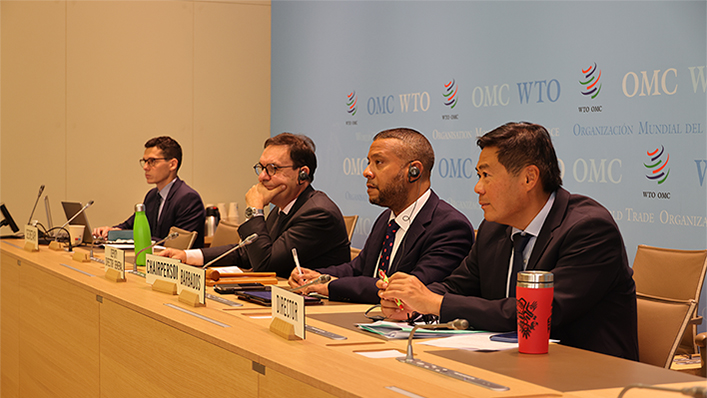
Ambassador Matthew Wilson from Barbados, Chair of the meeting, reiterated the challenging nature of the battle against plastics pollution. He pointed out that the world currently has 170 trillion plastic particles floating in the ocean, and by 2050, there will be more plastics than fish. In response, the WTO has taken action through the work of the Dialogue, as shown in the recent draft statement, he said.

Australia, representing the coordinators, introduced draft one of the MC13 statement. It expands upon the initial “draft zero” and outlines shared principles and various concrete actions related to trade aimed at reducing plastics pollution. The list of actions, including annexes (with details still to be developed), aims to reflect the discussions held over the past two years and to provide the foundation for collective efforts in addressing the challenge of plastics pollution.

Ecuador, a coordinator of the Dialogue, stressed the need to address plastics pollution throughout its lifecycle. Ecuador highlighted the importance of increased collaboration and synergy between the Dialogue and other international processes. These include ongoing negotiations led by the Intergovernmental Negotiating Committee on Plastic Pollution (INC) aimed at completing its work by the end of 2024 towards an international legally binding treaty on plastics pollution. Additionally, it noted the work of the World Customs Organization on amending the Harmonized System (HS) for traded goods and the existing regulations and guidelines of the Basel, Rotterdam and Stockholm conventions.

China, another coordinator of the Dialogue, emphasized the significance of a MC13 Ministerial Statement in harnessing trade to combat global plastics pollution. China encouraged further synergy between the Dialogue and the INC process, including enhancing coherence by defining key concepts such as “harmful and unnecessary plastics”.

Many co-sponsors of the Dialogue commended the progress made in the draft statement. They also offered various suggestions to enhance the draft, emphasizing their varied interests, including in promoting trade measures that would support non-plastic substitutes and alternatives, facilitate technology transfer, provide capacity building and funding to assist least developed countries and small island developing countries, address cross-border waste management, and adopt a balanced approach to addressing environmental, social and health concerns.

Additionally, some delegates noted the upcoming INC negotiation meeting in November and stressed the WTO’s unique position to contribute trade solutions to the process without precluding its outcomes. Several members shared the view that MC13 presented an excellent opportunity to send a strong signal to the INC and demonstrate the WTO’s strong commitment to implementing a future binding agreement on plastics pollution.

Representatives from international organizations and civil society also provided feedback on the draft statement, preceding the co-sponsors’ discussion, praising it as “commendable” work. They offered suggestions in various areas, notably adding a roadmap for future work, identifying specific products for trade reduction, securing a safe approach to plastics alternatives and substitutes to avoid solutions with regrettable consequences, addressing subsidies on plastics, and establishing a science-policy advisory panel to assess the safety of plastics substitutes.

In conclusion, the Chair expressed satisfaction with the feedback received during the meeting, affirming that it indicates the statement is on the right track, with expectations of more robust work ahead.

Next steps

Coordinators said that the annexes in the draft statement will remain a living document subject to periodic updates. They are currently in the process of preparing a factual report based on two surveys: one focused on trade-related measures relevant to plastics pollution reduction and another assessing plastics-related Aid for Trade needs. Additionally, they plan to revise the draft statement based on the feedback received thus far. Once finalized, both documents will be circulated among members and stakeholders.

The next meeting is scheduled for 16-17 November, following the November INC negotiation meeting, to facilitate more informed deliberations on the path forward.

More

Currently, 76 WTO members are participating in the Plastics Pollution Dialogue. Additional information about the Dialogue can be found on its dedicated webpage here.

Share

WTO members address electronic commerce and technology transfer in final thematic session

Source:

Ambassador Usha Dwarka-Canabady of Mauritius, the facilitator of the Work Programme on Electronic Commerce, welcomed the exchanges which took place at the meeting. These included experience-sharing by members and discussions on technical assistance aimed at helping developing members bring technology to the forefront of their economic development.

The meeting included a presentation by Egypt on an African Group communication regarding the  role of transfer of technology in resilience building (WT/GC/W/888). 

Egypt, on behalf of the African Group, said technology transfer is a vital component of building economic resilience, with e-commerce serving as both a catalyst and a beneficiary of technology transfer.  The African Group has emphasized the need for collaborative efforts, openness and inclusivity in the discussion of trade, technology transfer and sustainable development, with the WTO having an important role in contributing to this process, Egypt said.

Around 20 members took the floor to comment on the African Group communication.

The meeting also heard from Cambodia regarding its communication, “E-commerce Readiness Development and Challenges: The case of Cambodia” (WT/GC/W/900), as well as a brief presentation from South Africa on a recent market inquiry by its Competition Commission.

In closing the meeting, Ambassador Dwarka-Canabady said from next month the Work Programme would start working on the convergence of issues in the eight thematic discussions held and find what areas of convergence could give members a basis to move forward and to make recommendations to the WTO’s 13th Ministerial Conference (MC13) to be held in Abu Dhabi in February 2024. 

Share

Ukraine initiates WTO dispute complaints against Hungary, Poland and Slovak Republic

Source:

Ukraine claims the measures imposed by Hungary, Poland and the Slovak Republic appear to be inconsistent with various provisions under the WTO’s General Agreement on Tariffs and Trade 1994 and the Agreement on Agriculture.

Further information is available in documents WT/DS619/1, WT/DS620/1 and WT/DS621/1

What is a request for consultations?

The request for consultations formally initiates a dispute in the WTO. Consultations give the parties an opportunity to discuss the matter and to find a satisfactory solution without proceeding further with litigation. After 60 days, if consultations have failed to resolve the dispute, the complainant may request adjudication by a panel.

Share

Trade Policy Review: Central African Economic and Monetary Community (CEMAC)

Source:

The following documents are available:

Secretariat report

A detailed report written independently by the WTO Secretariat.

Government report

A policy statement by the government of the member under review.

From the meeting

The Secretariat and Government reports are discussed by the WTO’s full membership in the Trade Policy Review Body (TPRB).

Background

Trade Policy Reviews are an exercise, mandated in the WTO agreements, in which member countries’ trade and related policies are examined and evaluated at regular intervals. Significant developments that may have an impact on the global trading system are also monitored. All WTO members are subject to review, with the frequency of review varying according to their share of world trade.

Share

Members consider Argentina’s request for panel on US tube and pipe duties

Source:

DS617: United States — Anti-dumping measure on oil country tubular goods from Argentina

Argentina submitted its first request for the establishment of a panel to review the final anti-dumping (AD) measure imposed by the United States on OCTG from Argentina as well as certain provisions of US legislation regarding cumulation of imports in assessing injury caused by imports in AD and countervailing duty investigations.

The AD duty order was imposed by the US in November 2022, Argentina said, adding that the challenged measure implies enormous economic damage for Argentina. Argentina requested consultations with the US on the matter on 17 May but said the talks which took place on 6 July failed to resolve the matter, thus prompting its request for a panel.

The United States said the AD duties were imposed on OCTG from Argentina following a thorough  investigation by the U.S. Department of Commerce, and an equally thorough injury investigation by the U.S. International Trade Commission, which were fully consistent with WTO rules. For these reasons, the US said it could not agree to the establishment of a panel. 

The DSB took note of the statements and agreed to revert to the matter should the requesting member wish to do so.

DS601 China — Anti-Dumping measures on stainless steel products from Japan

China said it notified WTO members on 25 August of its intention to implement the recommendations and rulings of the DSB in the DS601 dispute case in a manner that respects its WTO obligations. China will need a reasonable period of time to do this and is currently in discussions with Japan on the matter, China said.

Japan said it welcomed China’s indication of its intention to comply with the ruling but said it has not yet been able to agree with China upon the reasonable period of time for implementation despite the fact that more than 45 days have passed since the DSB adoption of the ruling. Japan said it regrets that the discussions with China have not been as active as it had expected during the 45-days period and that it hopes to accelerate the discussions with China.

The European Union said it welcomed China’s intention to comply with its WTO obligations and said it was interested in hearing from China whether it also intends to bring into compliance its measures with respect to affected EU companies.

In response to Japan’s comment, China said it was on the same page with Japan in regard to accelerating the discussion on the reasonable period of time for implementation and that it has made every effort to reach an agreement with Japan bilaterally.  With regards to the EU, China said it will make sure its measures are in full compliance with the WTO ruling.

DS582: India — Tariff Treatment on Certain Goods in the Information and Communications Technology Sector

DS588: India — Tariff Treatment on Certain Goods in the Information and Communications Technology Sector

India, the European Union and Chinese Taipei requested additional time for the DSB to consider for adoption the panel rulings in the cases initiated by the EU and Chinese Taipei regarding India’s imposition of tariffs on certain high-tech goods.  The parties asked that the DSB further delay consideration of the panel reports until 18 December in order to help facilitate resolution of the disputes. The DSB had agreed to previous requests from the EU and Chinese Taipei to delay consideration until 19 September.

The United States said it welcomed the efforts of the parties to continue their engagement and it supports efforts to continue dialogue with the aim of achieving a mutually agreed solution. China urged India to adjust its inconsistent measures in accordance with WTO rules.

The DSB agreed to the requests from India, the EU and Chinese Taipei.

DS597: United States — Origin Marking Requirement

Reiterating statements made at previous DSB meetings, the United States once again highlighted its concerns regarding the panel ruling in DS597, citing the “serious systemic and practical implications” of the proceedings. The WTO does not have the competence or the authority to assess the national security assessments of a member, nor does it have the competence or authority to pass judgment on the importance that the United States places on fundamental freedoms and human rights, or actions taken to support those values, the US said.

In order to prevent further undermining of the WTO, members need to clarify and adopt a shared understanding of the essential security exception, which is a critical element in the international trading system and permits members to take on trade commitments to each other, the US said.

Hong Kong, China again criticized the US for putting this item for the fifth time on the DSB agenda despite the fact the US appealed the panel report. It is highly problematic for a losing party to keep criticizing openly at regular DSB meetings, time and again, rulings by an independent panel formed in line with WTO laws and procedures, said Hong Kong, China. It added that the DSB is not the forum for discussion of the internal affairs of any individual member.

China and Russia took the floor to criticize the US for continuing to put the item on the DSB agenda.

Appellate Body appointments

Guatemala, speaking on behalf of 130 members, introduced for the 68th time the group’s proposal to start the selection processes for filling vacancies on the Appellate Body. The extensive number of members submitting the proposal reflects a common concern over the current situation in the Appellate Body which is seriously affecting the overall WTO dispute settlement system against the best interest of members, Guatemala said for the group.

The United States repeated that it does not support the proposed decision to commence the appointment of Appellate Body members as its longstanding concerns with WTO dispute settlement remain unaddressed.  The US has been working with members to advance this goal; considerable work remains and achieving fundamental dispute settlement reform will not be easy, the US said, but working collectively towards that goal provides the greatest chance of achieving durable, lasting reform.

More than 20 delegations then took the floor in support of the proposal, with one speaking on behalf of a group of members. Many noted the commitment made by ministers at the WTO’s 12th Ministerial Conference to engage in discussions aimed at securing a fully functioning dispute settlement system by 2024 and pledged their support for securing an outcome by then.  Several noted the ongoing informal discussions taking place regarding dispute settlement reform and welcomed the intensified efforts being made there.

Six members made reference to the Multi-party interim appeal arrangement (MPIA) as a temporary alternative means available to securing an appeals review while the Appellate Body remains non-functioning.

Guatemala said that on behalf of the 130 members it regretted that for the 68th occasion members have not been able to launch the selection processes. Ongoing conversations about reform of the dispute settlement system should not prevent the Appellate Body from continuing to operate fully, and members should comply with their obligation under the Dispute Settlement Understanding to fill the vacancies as they arise, Guatemala said for the group.

Other business

The United States addressed the panel ruling in DS588 which was appealed by China. The panel rightly rejected China’s argument that the U.S. Section 232 actions are safeguard measures that may be “rebalanced” under WTO rules, the US said, instead seeing China’s measures for what they are: illegal retaliation.  The US said China’s use of the WTO dispute settlement system to challenge the U.S. Section 232 national security actions has caused grave systemic damage to the WTO and that WTO reform must ensure that issues of national security cannot be reviewed in WTO dispute settlement.

China noted its appeal and said there were errors in the panel’s findings regarding China’s actions.  China is concerned the findings of the panel invalidate the rights of WTO members to take rebalancing measures and to defend their legitimate rights and interests. The findings open another black hole for certain members to adopt unilateral and  protectionist measures to evade their WTO obligations, China said.  China urged the US to immediately withdraw its Section 232 measures and work with other members to restore a binding dispute settlement mechanism as soon as possible.

The European Union and Russia took the floor to voice their concerns with the panel’s findings.

Surveillance of implementation

The United States presented status reports with regard to DS184, “US — Anti-Dumping Measures on Certain Hot-Rolled Steel Products from Japan”,  DS160, “United States — Section 110(5) of US Copyright Act”, DS464, “United States — Anti-Dumping and Countervailing Measures on Large Residential Washers from Korea”, and DS471, “United States — Certain Methodologies and their Application to Anti-Dumping Proceedings Involving China.”

The European Union presented a status report with regard to DS291, “EC — Measures Affecting the Approval and Marketing of Biotech Products.”

Indonesia presented its status reports in DS477 and DS478, “Indonesia — Importation of Horticultural Products, Animals and Animal Products.” 

Next meeting

The next regular DSB meeting will take place on 26 October.

Share

WRISE Group Appoints Group COO and Group Head of Risk & Compliance to Strengthen Commitment to Core Business Fundamentals

Source:

HONG KONG SAR – Media OutReach – 26 September 2023 – WRISE Group today announced the appointments of Helen Lam as Group Chief Operating Officer (“COO”), and Gaven Koh as Group Head of Risk and Compliance of WRISE Group. Both positions are effective immediately.

The appointments come amidst a pivotal juncture for the Group, aligning with its regional expansion strategy, while reinforcing WRISE’s dedication to building core fundamentals such as governance, risk management, and compliance.

Both roles will enhance the Group’s operational effectiveness and its ability to meet regulatory compliance standards, further bolstering the organisation’s efficient and effective day-to-day operations amidst continued growth across Asia.

Control and governance of the WRISE Group, alongside the implementation of robust risk management measures, are crucial in WRISE’s growth plans and strategy as we continue to serve clients and expand across markets. Ms. Lam will ensure oversight of the governance and operations of the Group, and Mr Koh will manage all compliance-related requirements of internal and external stakeholders such as risk assessments, frameworks, policies and guidelines. Both report to Derrick Tan, Chairman, WRISE Group.

“Helen and Gaven possess extensive experience and deep industry knowledge that will boost WRISE’s growth momentum. I am confident that they will play vital roles in strengthening WRISE’s capabilities and elevating the services we provide for clients globally. The appointment of such key roles within WRISE also reflect our commitment to investing in core principles and strong fundamentals to build our business,” said Derrick Tan, Chairman, WRISE Group.

“I am excited to join the team at WRISE, and I look forward to working with WRISE’s leadership team to contribute to the continued success of the company. With Asia’s growing wealth management market, there is no better time to help ultra-high net worth individuals and family offices navigate market complexities with WRISE’s unique platform and offerings,” said Ms. Lam.

“I look forward to working closely with Derrick, Helen and the team at WRISE to cultivate a strong culture of compliance and risk resilience. It is not just corporate responsibility, but also an opportunity to fortify our foundation and empower WRISE Group’s growth journey,” said Mr. Koh.

Ms. Lam brings over 20 years of experience as a veteran in the wealth management industry, having assumed leadership responsibilities at prominent financial institutions in Hong Kong. Prior to joining WRISE, Ms. Lam spearheaded strategic business operations at the Bank of Singapore Hong Kong branch, responsible for overall control and governance of the business, including managing audit reviews and front-office compliance matters. She also held high-level management positions and drove transformative efforts across compliance, controls and risk management for financial institutions including Citi Private Bank Asia Pacific and Deutsche Bank A.G. Hong Kong.

Mr. Koh has over 12 years of experience in the private banking industry, with a proven track record in risk control, compliance, transactions monitoring and investigations. Prior to joining WRISE, he led a team at Credit Suisse AG of 30 compliance analysts across Asia Pacific. Mr Koh has held leadership positions at various financial institutions in Singapore, managing teams across client review and monitoring, and anti-money laundering functions. Before joining the financial sector, Mr Koh was formerly an investigation officer with the Commercial Affairs Department under the Singapore Police Force.< >

Hashtag: #WRISEGroup

The issuer is solely responsible for the content of this announcement.

– Published and distributed with permission of Media-Outreach.com.

China’s Gutian County successfully held the Forum on Master Yuanying and the Sinicization of Religion following its debut on the NASDAQ screen

Source:

GUTIAN, CHINA – Media OutReach – 26 September 2023 – In a continued effort to promote the integration and development of Chinese and world civilizations, Gutian County is proud to host the Forum on Master Yuanying and the Sinicization of Religion from September 25 to 27.

< >Set against the scenic backdrop of Cuiping Lake, this event with the “Wisdom Mutual Learning · Harmony and Integration” theme has participants from all corners of the globe. Representatives of governments, Chinese compatriots from Hong Kong, Macao, and Taiwan, overseas Chinese, and prominent monks and scholars studying the Sinicization of Buddhism from around the world, and enthusiasts of Yuanying culture, gathered in Gutian to actively engage in cultural exchanges and enhance mutual learning among civilizations.

Master Yuan Ying is a patriotic monk and Buddhist leader in modern China. He always adheres to the spirit of ” compassion, fearlessness, and selflessness” and has made many contributions to the development of Buddhist culture around the world. As the birthplace of Master Yuanying, Gutian relies on the forum activities of Master Yuanying and the Sinicization of Religion to fully inherit and promote Yuanying culture. While polishing the cultural card of “Patriotic Monk Yuanying’s Hometown”, it promotes Buddhist cultural exchange and enhances mutual learning among world civilizations.

Having recently showcased its cultural and historical gems on the NASDAQ screen in Times Square, New York, Gutian County continues to receive international attention. The promotional video displayed in Times Square before the beginning of the forum not only celebrated Gutian’s legacy as the “capital of edible fungi in China” and the “hometown of Hydropower” but also highlighted its deep-rooted cultural significance.

The video encapsulated the spirit and essence of Gutian County, shining a spotlight on the radiant Chinese civilization. As Gutian intertwined its majestic landscapes with its rich history, it stood as a testament to the deep-seated culture, ultimately allowing the unique charm of Oriental culture to unfurl to the world. With Gutian’s debut on the NASDAQ screen, the brilliance of Chinese civilization took center stage on a global platform. It is regarded as the preface of the forum.

This forum is yet another step forward in sharing its profound wisdom and inviting harmony and integration with the world.

Hashtag: #GutianCounty

The issuer is solely responsible for the content of this announcement.

– Published and distributed with permission of Media-Outreach.com.