IBM Announced as Sponsor of 2023 U.N. Climate Change Conference (COP28)

Source:

IBM’s continued involvement in the U.N. effort builds on a long legacy of research and action on global challenges in collaboration with governments and civil society. IBM will demonstrate the power of AI and technology in driving progress on sustainability goals and improving business efficiency.
Sep 13, 2023

LONDON, UK, September 13, 2023 – IBM (NYSE: IBM) today announced its role as an Associate Pathway Partner of the 2023 United Nations Climate Change Conference (COP28). The conference, which will be hosted by the COP28 UAE Presidency in Dubai from November 30 to December 12, will be a pivotal moment for global leaders, policymakers, scientists, and businesses to collaborate on climate action and work together to shape a more sustainable future.
Throughout the conference, IBM will showcase how technology and consulting can enable business, society, and government to accelerate progress toward sustainability goals. By consolidating data and embedding AI into core functions, IBM can offer organizations tools to help them reduce costs, waste, and emissions; advance transitions to clean energy; improve productivity; and develop more sustainable supply chains and responsible computing. IBM can also help organizations measure their environmental impact, report against regulatory requirements and public expectations, and operationalize their data to help create more efficient and sustainable enterprises—without compromising profitability.
“Sustainability is one of the biggest challenges of our lifetime, and both technology and partnerships will be key to driving future progress,” said Jonathan Adashek, Senior Vice President, Marketing and Communications, IBM. “AI innovations like IBM’s watsonx are already available to help organizations build AI to drive sustainability and efficiency. In Dubai, IBM will support the COP28 UAE Presidency’s agenda by working with attendees to continue collaborating on solutions that move us all toward a low-carbon future.”
“A wide range of stakeholders are key to ensuring COP28’s success, and we are proud of the high level of interest in sponsorships received from across the world. All organizations and sectors of society have an important role to play in climate action, and I am encouraged by the enthusiasm demonstrated by our sponsors who are committing to Unite, Act, and Deliver to keep 1.5C within reach,” said Ambassador Majid Al Suwaidi, Director-General and Special Representative of the 28th Conference of the Parties to the UN Framework Convention on Climate Change (COP28).
IBM’s role at COP28 builds on the company’s long history of action, research, and advocacy around the environment. The company issued its first environmental policy more than 50 years ago—in 1971—and published a formal position on climate change in 2007. IBM is also a founding member of the United Nations Environment Programme’s Science-Policy-Business Forum on the Environment and the Climate Leadership Council, and supports communities vulnerable to climate change and other environmental issues through initiatives like the IBM Sustainability Accelerator.
The location of this year’s U.N. Climate Change Conference is also a backdrop to IBM’s presence in the Middle East region, where its sustainability offerings are helping businesses and governments improve efficiency and advance their sustainability goals. For instance, IBM and the Mohammed bin Zayed University of Artificial Intelligence (MBZUAI) are collaborating through a joint AI Center of Excellence to improve the adoption of AI technology, inform the deployment of clean and renewable energy, and help drive sustainability with carbon neutral solutions.
For additional information on IBM’s sustainability solutions please visit: https://www.ibm.com/sustainability. 

About IBMIBM is a leading provider of global hybrid cloud and AI, and consulting expertise. We help clients in more than 175 countries capitalize on insights from their data, streamline business processes, reduce costs, and gain the competitive edge in their industries. More than 4,000 government and corporate entities in critical infrastructure areas such as financial services, telecommunications and healthcare rely on IBM’s hybrid cloud platform and Red Hat OpenShift to affect their digital transformations quickly, efficiently, and securely. IBM’s breakthrough innovations in AI, quantum computing, industry-specific cloud solutions and consulting deliver open and flexible options to our clients. All of this is backed by IBM’s legendary commitment to trust, transparency, responsibility, inclusivity, and service.Visit www.ibm.com for more information.

Media contact
Imtiaz MuftiIBM External Communications UK&IImtiaz.Mufti@ibm.comEmail: Imtiaz.Mufti@ibm.comTele: +44 (0)772 1211 048

The Platform for Digital and Quantum Innovation of Quebec (PINQ²) Proudly Announces the Historic Inauguration of an IBM Quantum System One Quantum Computer in Bromont

Source:

Bromont, Quebec, September 22, 2023 – The Platform for Digital and Quantum Innovation of Quebec (PINQ²), a non-profit organization (NPO) founded by the Ministry of Economy, Innovation and Energy of Quebec (MEIE – ministère de l’Économie, de l’Innovation et de l’Énergie du Québec) and the Université de Sherbrooke, along with IBM, are proud to announce the historic inauguration of an IBM Quantum System One at IBM Bromont. This event marks a major turning point in the field of information technology and all sectors of innovation in Quebec, making PINQ² the sole administrator to inaugurate and operate an IBM Quantum System One in Canada. To date, this is one of the most advanced quantum computers in IBM’s global fleet of quantum computers.
This new quantum computer in Quebec reinforces Quebec’s and Canada’s position as a force in the rapidly advancing field of quantum computing, opening new prospects for the technological future of the province and the country. Access to this technology is a considerable asset not only for the ecosystem of DistriQ, the quantum innovation zone for Quebec, but also for the Technum Québec innovation zone, the new “Energy Transition Valley” innovation zone and other strategic sectors for Quebec.

The Platform for Digital and Quantum Innovation of Quebec (PINQ²) announces the historic inauguration of an IBM Quantum System One Quantum Computer in Bromont, Quebec. (Credit: Ryan Lavine for IBM.)
“The installation of this IBM quantum computer is a giant leap that will promote the growth of Quebec’s quantum sciences ecosystem and the development of our DistriQ innovation zones in Sherbrooke and Technum Québec in Bromont. This is a showcase for Quebec, which will be recognized as a force in quantum sciences, but also in international sustainable development,” said Pierre Fitzgibbon, Minister of Economy, Innovation and Energy, Minister responsible for Regional Economic Development and Minister responsible for Greater Montreal and the Montreal Region.
“The objective of DistriQ is to create the world’s largest commercial quantum research infrastructure,” explained Richard St-Pierre, General Manager, DistriQ, Sherbrooke’s Quantum Innovation Zone. “PINQ²’s hybrid quantum computer is a unique and powerful asset that will allow the Innovation Zone’s companies to reach their objectives; we are very proud of this partnership.”
In addition to having access to an IBM Quantum System One, the high-performance computing centre (HPC) set up at the Humano District in Sherbrooke will enable PINQ² to offer a hybrid computing approach. This technological capability will provide businesses with a unique opportunity to access a full range of hybrid quantum computing service. PINQ² offers businesses an easy and seamless experience to assess the potential of digital and quantum technologies and innovations within their existing processes, with an emphasis on specific sectors such as healthcare, energy, manufacturing, the environment and sustainable development.
As part of the partnership between PINQ² and IBM announced in July 2023, the two organizations will lead a world-class quantum working group dedicated to exploring quantum computing to develop solutions to sustainability challenges. This working group will be supported by the valuable contributions of founding members: Hydro-Québec and the Université de Sherbrooke through its Institut Quantique.
“For the energy sector, the ongoing energy and digital transitions impose the need for increasingly efficient calculations in terms of R&D and application development, a need that will grow significantly in the coming years,” said Christian Bélanger, Senior Director – Research & Innovation at Hydro-Québec. “At our research center, we are already working hard to tackle the challenges of the energy transition. We believe that quantum technologies that PINQ² gives access to offers promising prospects and rich opportunities for value creation in terms of energy and technological solutions for Hydro-Québec. We will most certainly be exploring and harnessing the potential of these technologies as they evolve.”
Discovery Accelerator
PINQ² is currently the only entity to offer access to an IBM Quantum System One situated in Canada, and PINQ² positions Quebec as the only other place in the world, outside of the United States, to be engaged in an IBM Discovery Accelerator associated with its own high-performance computing infrastructure and a quantum computer entirely dedicated to research and industrial innovation.
“Quantum computing is accelerating at a rapid pace. This is in large part due to a growing global ecosystem that continues to push the boundaries of what is possible,” said Jay Gambetta, Vice President, IBM Quantum. “Our partnership with PINQ² to deploy an IBM Quantum System One in Quebec, Canada marks a significant milestone in quantum technological and scientific progress, and enables the region’s strong culture of innovation and talent to help extend the frontiers of quantum computing’s potential.”
A first Centre of Excellence in quantum software development
PINQ² is also proud to announce the establishment of its Center of Excellence, aimed at accelerating the adoption of quantum technologies by providing accessible access to PINQ²’s infrastructure for businesses and researchers. The Center of Excellence will support a community dedicated to quantum software, making it easier to use, create, and foster dynamic collaboration, all while setting industry benchmarks in software engineering.
With the goal of making quantum technologies accessible to all, the Center of Excellence will evolve into a platform offering training opportunities, collaborative projects with universities and industry partners, and the development of open-source algorithms. As the inaugural partner in this initiative, the École de Technologie Supérieure (ÉTS) is contributing a team of researchers dedicated to democratizing best practices in quantum software.
A historic turning point for the province and the country
“At PINQ², our passion for digital and quantum innovation is our driving force,” said Éric Capelle, General Manager of PINQ². “The inauguration of an IBM Quantum System One quantum computer marks a historic turning point for Quebec and Canada. We are proud to play a key role in this technological revolution.
“In addition to this news, PINQ² is accelerating its services for businesses.  We are working with a network of Canadian academic partners such as IVADO, Université de Sherbrooke, University of Saskatchewan, Quantum Algorithms Institute and Concordia University to collaborate with this industry and train quantum talent.
“We are also proud to announce the creation of a multidisciplinary team to accelerate the development of quantum business solutions through the Centre of Excellence in Quantum Hybrid Software Engineering, as well as the deployment on our platform of a first curriculum dedicated to professionals and available to PINQ² customers.”About PINQ² 
The Platform for Digital and Quantum Innovation of Quebec is a non-profit organization created by the Université de Sherbrooke and the ministère de l’Économie, de l’Innovation et de l’Énergie du Québec (Ministry of Economy, Innovation and Energy of Quebec) in 2020. Its mission is to support organizations in accelerating their digital transformation, to enhance collaboration, and to simplify technology transfers between industries and research, in addition to training the talents of tomorrow.
About IBM
IBM is a leading provider of global hybrid cloud and AI, and consulting expertise. We help clients in more than 175 countries capitalize on insights from their data, streamline business processes, reduce costs and gain the competitive edge in their industries. More than 4,000 government and corporate entities in critical infrastructure areas such as financial services, telecommunications and healthcare rely on IBM’s hybrid cloud platform and Red Hat OpenShift to effect their digital transformations quickly, efficiently and securely. IBM’s breakthrough innovations in AI, quantum computing, industry-specific cloud solutions and consulting deliver open and flexible options to our clients. All of this is backed by IBM’s long-standing commitment to trust, transparency, responsibility, inclusivity and service.
For more information, visit www.ibm.com
About IBM Quantum System One
Quantum computing is an emerging technology that exploits the laws of quantum mechanics to solve certain problems that today’s most powerful supercomputers cannot practically solve. IBM Quantum System One is the first integrated quantum system with a compact design optimized for stability, reliability and continuous use. It has been deployed in a number of sites around the world, in Germany, Japan, the United States and now Canada. Its 127-qubit utility processor will offer improved coherence times and lower error rates than IBM’s previous quantum systems.
*Pictured in image: L-R: Alessandro Curioni, IBM Fellow and Vice President Europe and Africa and Director IBM Research Zurich, IBM; Jamie Thomas, General Manager, Technology Lifecycle Services and IBM Enterprise Security Executive, IBM; Stéphane Tremblay, Chief Director, Bromont, Site Location Executive, IBM Canada; Nathalie Le Prohon, Director, IBM Technologies, Québec, IBM; Dave McCann, President, IBM Canada and Associate Director, IBM Consulting Canada, IBM; Isabelle Charest, Minister Responsible for Sport, Recreation and the Outdoors, Government of Québec; Jay Gambetta, IBM Fellow and Vice President, IBM Quantum, IBM; Pierre Fitzgibbon, Minister of Economy and Innovation and Energy, Government of Québec; Eric Capelle, CEO, PINQ²; Marie-Eve Boulanger, Program Manager – Quantum, PINQ²; Richard St-Pierre, Executive Director of DistriQ, Quantum Innovation Zone of Québec.

Press contacts:
Simon Fauchersfaucher@zonefrancherp.com514-402-3873
Marie Foucherotmfoucherot@zonefrancherp.com579-372-6015
Lorraine BaldwinIBM Canada Communicationslorraine@ca.ibm.com
Katia Moskvitchkam@zurich.ibm.com+41 78208 9666

Money Market Operations as on September 25, 2023

Source:


(Amount in ₹ crore, Rate in Per cent)

  Volume
(One Leg)
Weighted
Average Rate
Range
A. Overnight Segment (I+II+III+IV) 512,047.91 6.77 5.00-7.80
     I. Call Money 9,966.15 6.75 5.00-6.85
     II. Triparty Repo 367,646.70 6.76 6.75-6.84
     III. Market Repo 134,345.06 6.79 6.01-6.90
     IV. Repo in Corporate Bond 90.00 7.51 6.75-7.80
B. Term Segment      
     I. Notice Money** 373.12 6.68 6.05-6.85
     II. Term Money@@ 325.00 6.75-7.15
     III. Triparty Repo 0.00
     IV. Market Repo 0.00
     V. Repo in Corporate Bond 0.00
  Auction Date Tenor (Days) Maturity Date Amount Current Rate /
Cut off Rate
C. Liquidity Adjustment Facility (LAF), Marginal Standing Facility (MSF) & Standing Deposit Facility (SDF)
I. Today’s Operations
1. Fixed Rate          
2. Variable Rate&          
  (I) Main Operation          
     (a) Repo          
     (b) Reverse Repo          
  (II) Fine Tuning Operations          
     (a) Repo          
     (b) Reverse Repo          
3. MSF Mon, 25/09/2023 1 Tue, 26/09/2023 184,946.00 6.75
4. SDFΔ Mon, 25/09/2023 1 Tue, 26/09/2023 57,929.00 6.25
5. Net liquidity injected from today’s operations [injection (+)/absorption (-)]*       127,017.00  
II. Outstanding Operations
1. Fixed Rate          
2. Variable Rate&          
  (I) Main Operation          
     (a) Repo          
     (b) Reverse Repo Fri, 22/09/2023 14 Fri, 06/10/2023 5,995.00 6.49
  (II) Fine Tuning Operations          
     (a) Repo          
     (b) Reverse Repo          
3. MSF          
4. SDFΔ          
5. On Tap Targeted Long Term Repo Operations Mon, 22/03/2021 1095 Thu, 21/03/2024 5,000.00 4.00
Mon, 14/06/2021 1096 Fri, 14/06/2024 320.00 4.00
Mon, 30/08/2021 1095 Thu, 29/08/2024 50.00 4.00
Mon, 13/09/2021 1095 Thu, 12/09/2024 200.00 4.00
Mon, 27/09/2021 1095 Thu, 26/09/2024 600.00 4.00
Mon, 04/10/2021 1095 Thu, 03/10/2024 350.00 4.00
Mon, 15/11/2021 1095 Thu, 14/11/2024 250.00 4.00
Mon, 27/12/2021 1095 Thu, 26/12/2024 2,275.00 4.00
6. Special Long-Term Repo Operations (SLTRO) for Small Finance Banks (SFBs)£ Mon, 17/05/2021 1095 Thu, 16/05/2024 400.00 4.00
Tue, 15/06/2021 1095 Fri, 14/06/2024 490.00 4.00
Thu, 15/07/2021 1093 Fri, 12/07/2024 750.00 4.00
Tue, 17/08/2021 1095 Fri, 16/08/2024 250.00 4.00
Wed, 15/09/2021 1094 Fri, 13/09/2024 150.00 4.00
Mon, 15/11/2021 1095 Thu, 14/11/2024 105.00 4.00
Mon, 22/11/2021 1095 Thu, 21/11/2024 100.00 4.00
Mon, 29/11/2021 1095 Thu, 28/11/2024 305.00 4.00
Mon, 13/12/2021 1095 Thu, 12/12/2024 150.00 4.00
Mon, 20/12/2021 1095 Thu, 19/12/2024 100.00 4.00
Mon, 27/12/2021 1095 Thu, 26/12/2024 255.00 4.00
D. Standing Liquidity Facility (SLF) Availed from RBI$       3,053.94  
E. Net liquidity injected from outstanding operations [injection (+)/absorption (-)]*     9,158.94  
F. Net liquidity injected (outstanding including today’s operations) [injection (+)/absorption (-)]*     136,175.94  
G. Cash Reserves Position of Scheduled Commercial Banks
     (i) Cash balances with RBI as on September 25, 2023 942,101.12  
     (ii) Average daily cash reserve requirement for the fortnight ending October 06, 2023 957,323.00  
H. Government of India Surplus Cash Balance Reckoned for Auction as on¥ September 25, 2023 0.00  
I. Net durable liquidity [surplus (+)/deficit (-)] as on September 08, 2023 236,206.00  
@ Based on Reserve Bank of India (RBI) / Clearing Corporation of India Limited (CCIL).
– Not Applicable / No Transaction.
** Relates to uncollateralized transactions of 2 to 14 days tenor.
@@ Relates to uncollateralized transactions of 15 days to one year tenor.
$ Includes refinance facilities extended by RBI.
& As per the Press Release No. 2019-2020/1900 dated February 06, 2020.
Δ As per the Press Release No. 2022-2023/41 dated April 08, 2022.
* Net liquidity is calculated as Repo+MSF+SLF-Reverse Repo-SDF.
As per the Press Release No. 2020-2021/520 dated October 21, 2020, Press Release No. 2020-2021/763 dated December 11, 2020, Press Release No. 2020-2021/1057 dated February 05, 2021 and Press Release No. 2021-2022/695 dated August 13, 2021.
¥ As per the Press Release No. 2014-2015/1971 dated March 19, 2015.
£ As per the Press Release No. 2021-2022/181 dated May 07, 2021 and Press Release No. 2021-2022/1023 dated October 11, 2021.
Ajit Prasad            
Director (Communications)
Press Release: 2023-2024/990

Samsung Electronics’ Industry-First LPCAMM Ushers in Future of Memory Modules

Source:

 
Samsung Electronics, a world leader in advanced memory technology, today announced that it has developed the industry’s first Low Power Compression Attached Memory Module (LPCAMM) form factor, which is expected to transform the DRAM1 market for PCs and laptops — and potentially even data centers. Samsung’s groundbreaking development for its 7.5 gigabits-per-second (Gbps) LPCAMM has completed system verification through Intel’s platform.


Historically, PCs and laptops have conventionally used LPDDR DRAM or DDR-based So-DIMMs.2 While LPDDR is compact, it’s permanently attached to the motherboard, making it challenging to replace during repairs or upgrades. On the other hand, So-DIMMs can be attached or detached easily but have limitations with performance and other physical features.
 
LPCAMM overcomes the shortcomings of both LPDDR and So-DIMMs, addressing the increased demand for more efficient yet compact devices. Being a detachable module, LPCAMM offers enhanced flexibility for PC and laptop manufacturers during the production process. Compared to So-DIMM, LPCAMM occupies up to 60% less space on the motherboard. This allows more efficient use of devices’ internal space while also improving performance by up to 50% and power efficiency by up to 70%.
 
LPDDR’s power-saving features have made it an attractive option for servers, since it could potentially improve total cost of operation (TCO) efficiency. However, using LPDDR can create operational difficulties such as the need to replace the entire motherboard when upgrading a server’s DRAM specifications. LPCAMM offers a solution to these challenges, creating significant potential for it to become the solution of choice for future data centers and servers.
 
“The energy efficiency and repairability advantages of LPCAMM make this new form factor a game changer in today’s PC market,” said Dr. Dimitrios Ziakas, Vice President of Memory & IO Technology at Intel. “We’re excited to be a part of the new standard enabling the client PC ecosystem and pave the path for future adoption and innovation in broader market segments.”
 
“With the growing demand in innovative memory solutions encompassing high performance, low power consumption and manufacturing flexibility across various fields, LPCAMM is expected to gain wide adoption in PCs, laptops and data centers,” said Yongcheol Bae, Executive Vice President of Memory Product Planning Team at Samsung Electronics. “Samsung is committed to actively pursuing opportunities to expand the LPCAMM solution market and collaborating closely with the industry to explore new applications for its use.”
 
LPCAMM is set to be tested using next-generation systems with major customers this year, and commercialization is planned for 2024.
 
To learn more about Samsung’s LPDDR products, please visit this address.
 
 
1 DRAM: Dynamic Random Access Memory
2 So-DIMM: Small outline Dual In-line Memory Module

HKSTP and Global Entrepreneurship Network Join Forces to Propel Innovators from 200 Markets to Success Across the World

Source:

HONG KONG SAR – Media OutReach – 26 September 2023 – The Hong Kong Science and Technology Parks Corporation (HKSTP), has joined forces with the Global Entrepreneurship Network (GEN) to lead aspiring innovators to global growth opportunities, and extend Hong Kong’s innovation ecosystem to GEN’s 200 markets around the world. HKSTP led a delegation to Australia and attending the Global Entrepreneurship Congress 2023 in Melbourne to explore collaboration opportunities and ignite market discovery initiatives.

< >GEN is a global community that fosters deeper cross-border collaboration and initiatives between entrepreneurs, investors, researchers, policy makers and entrepreneurial support organisations, to make it easier for anyone, anywhere to start and scale a business.

In July this year, John Lee, the Chief Executive of HKSAR, witnessed an MoU signed by Jonathan Ortmans, GEN Founder and President and Dr Sunny Chai, Chairman of HKSTP, committing the two parties to support entrepreneurship across ASEAN countries. To expedite the partnership, HKSTP joined GEC 2023 in Melbourne from 19-22 September with a delegation of fast-rising startups and business leaders from Hong Kong. The delegation highlighted Hong Kong’s world-class I&T ecosystem and potential for collaboration with their counterparts from GEN’s global network. The infusion of new talent and ventures will further boost Hong Kong’s mission towards an international I&T hub, creating opportunities for all innovators.

Ir Dr HL Yiu, Chief Corporate Development Officer of HKSTP, said, “HKSTP is committed to growing collaboration with the worldwide innovation community through our partnership with GEN. Entrepreneurs all face common challenges in the startup-to-scale-up journey and Hong Kong’s unique integrated innovation ecosystem provides funding, R&D, talent and go-to-market opportunities to the world. Both HKSTP and GEN share the same vision of fostering global innovation, collaborating and growing our respective ecosystems to reach new levels of success.”

The collaboration with GEN commits both parties to exchange programmes and activities to drive cross-border and cross-sector collaboration with a focus on Green Tech, Life Sciences, Advanced Manufacturing, SmartCity, Mobility, AI, and Fintech. GEN’s annual flagship events such as Global Entrepreneurship Week and the Global Entrepreneurship Congress, provide ideal platforms to expand Hong Kong’s I&T ecosystem to new markets.

“GEN is committed to connecting entrepreneurs to opportunities that help them start and scale,” said Jonathan Ortmans, Founder and President of the Global Entrepreneurship Network. “We are proud to be deepening collaboration with the HKSTP to advance the interest of both local and global founders.”

The HKSTP Australia delegation leveraged the Global Entrepreneurship Congress, which featured three days of actionable intelligence from various sectors. It gathered thousands of voices, from 200+ countries to participate in creating an inclusive global ecosystem by networking, learning and sharing. The delegation also met with representatives from the startup community, universities, government bodies and investors in Australia to further explore business and collaboration opportunities. In addition, the delegation shared experiences and exchanged ideas with Australian tech ventures who are interested in learning and exploring the Hong Kong market.

HKSTP also introduced its Market Discovery Programme in Hong Kong and shared details with enterprises interested in expanding into Hong Kong, the GBA and mainland China markets. The two-day intensive Market Discovery Programme will be held in Hong Kong on 6-7 November 2023, packed with seminars, tours and networking opportunities to connect entrepreneurs with experts, investors, corporate leaders as well as entrepreneurs with past success in expanding their business within the region. The by-invitation programme is free-of-charge and participants can experience a stay at the Science Park’s InnoCell smart living co-creation space to spark collaboration with Science Park’s I&T talents.

For details, please visit: www.hkstp.org/our-community/events-and-happenings/expand-in-china-with-confidence/

Hashtag: #HKSTP

The issuer is solely responsible for the content of this announcement.

– Published and distributed with permission of Media-Outreach.com.

Audio: Chairperson’s concluding remarks

Source:

The following documents are available:

Secretariat report

A detailed report written independently by the WTO Secretariat.

Government report

A policy statement by the government of the member under review.

From the meeting

The Secretariat and Government reports are discussed by the WTO’s full membership in the Trade Policy Review Body (TPRB).

Background

Trade Policy Reviews are an exercise, mandated in the WTO agreements, in which member countries’ trade and related policies are examined and evaluated at regular intervals. Significant developments that may have an impact on the global trading system are also monitored. All WTO members are subject to review, with the frequency of review varying according to their share of world trade.

Share

Advanced Course on Trade in Services for government officials concludes at WTO

Source:

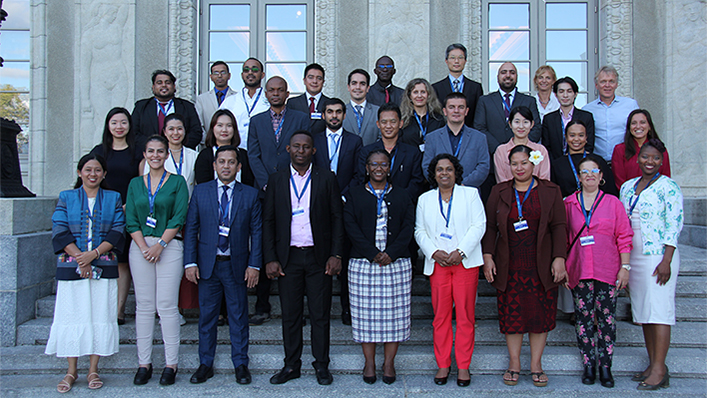
The course was organized jointly by the WTO Trade in Services Division and the Institute for Training and Technical Cooperation.

Participants deepened their understanding of the main provisions of the General Agreement on Trade in Services (GATS) and analysed key features of recent regional trade agreements. They also explored recent trends in world services trade, the latest developments in measuring services trade, and various tools for trade policy analysis. Participants also discussed topical issues in services trade policy, such as e-commerce, investment facilitation and environmental services.

Mr Uzoma Desmond Idu-Odaiche, official from Nigeria’s Ministry of Industry, Trade and Investment, said: “This course allowed me to enhance my knowledge of trade in services and to familiarize myself with the main provisions in trade agreements. It has also equipped me with the tools needed to involve our private sector operators by educating them on the benefits of engagement in trading services.”

Ms Verónica Gabriela López Gilli, official from Argentina’s Ministry of Foreign Affairs, International Trade and Worship, said: “This course has helped me enhance my knowledge of emerging trends in services and equipped me with relevant tools for the tasks that I undertake in terms of services and investments.”

Mr Berisford Codd, who works in Belize’s Directorate General for Foreign Trade, said: “This course has allowed me to gain more insight into some of the latest negotiations that have been happening at the WTO on domestic services, service regulations and investment facilitation for development. ”

The course programme is available here.

The list of participants is below:

 Argentina

Mrs. Verónica Gabriela López Gilli
Director of Digital Economy, Services, Investment, Government Procurement and Intellectual Property
Ministry of Foreign Affairs, International Trade and Worship

Bangladesh

Mr. Mohammad Mashooqur Rahman Sikder
Deputy Secretary
Ministry of Commerce

Belize

Mr. Berisford Codd
Trade Economist II
Directorate General for Foreign Trade

Bhutan

Mr. Tashi Dorji
Chief Industries Officer
Ministry of Industry, Commerce and Employment

Bosnia and Herzegovina

Mr. Faris Godinjak
Senior Advisor for Foreign Trade Policy and Control
Ministry of Foreign Trade and Economic Relations

Chile

Mr. Juan Salvador Bonilla Ibañez
Adviser
Ministry of Foreign Affairs

China

Mrs. Zihan Yi
Second Secretary
Ministry of Commerce

Costa Rica

Mrs. Paola María López Ulate
Advisor for the Trade in Services and Digital Economy Division
Ministry of Foreign Trade

Côte d’Ivoire

Mr. Max-Bertin Djacore
Deputy Director of Bilateral and Regional Trade Cooperation
Ministry of Commerce, Industry and SMEs Promotion

Democratic Republic of the Congo

Mr. Julio Muya Kunda
Office Coordinator
Ministry of Foreign Trade

Ecuador

Mrs. Stephanie Gabriela Moreno Pacheco
Director of Trade in Services Negotiations and Double Taxation
Ministry of Production, Foreign Trade, Investments and Fisheries

Hong Kong, China

Ms. Ying Hin Wong
Trade Officer
Trade and Industry Department

India

Mr. Anuj Ojha
Deputy Director
Ministry of Commerce and Industry

Jordan

Mr. Mohammad Ghanem
Head of Trade Policy Department
Ministry of Industry, Trade and Supply

Lao People’s Democratic Republic

Mrs. Savankham Phongsavath
Trade Officer
Department of Foreign Trade Policy

Lesotho

Ms. Mahlompho Ayanda Selapane
Principal Trade Development Officer
Ministry of Trade, Industry, Business Development and Tourism

Mexico

Mr. Guillermo Medellin
Director
Ministry of Economy

Morocco

Mrs. Siham Belakbir
Executive
Ministry of Industry and Commerce

Myanmar

Mrs. Win Min Phyoe
Director
Ministry of Commerce

Namibia

Mrs. Diana Tjiposa
Deputy Director, Trade and Policy Negotiations
Ministry of Industrialisation and Trade

Nigeria

Mr. Uzoma Desmond Idu-Odaiche
Assistant Chief Commercial Officer
Ministry of Industry, Trade and Investment

Oman

Mr. Adnan Al-Shahi
Head of Industrial Cooperation Section
Ministry of Commerce, Industry and Investment Promotion

Philippines

Ms. Raissa Faminial
Senior Trade and Industry Development Specialist
Department of Trade and Industry

Samoa

Mrs. Keity Fereita Siniva Tuiloma
Principal Project Management Officer
Ministry of Commerce, Industry and Labour

Singapore

Mr. Shawn Teck Choon Lui
Senior Assistant Director
Ministry of Trade and Industry

Sri Lanka

Mrs. Dona Abegunawardana Seevali Wijewantha
Deputy Director of Commerce
Ministy of Trade, Commerce and Food Security

Chinese Taipei

Mr. Yii-Feng Chang
Deputy Assistant Trade Representative
Office of Trade Negotiations

Thailand

Ms. Nuntirat Klaiklueng
Trade Officer
Ministry of Commerce

United Arab Emirates

Mr. Abdulla Aldhuhoori
Economic Researcher
Ministry of Economy

Share

Members prepare for line-by-line negotiations on draft fisheries subsidies text in October

Source:

“This was a pivotal week for our process. In this week, we have turned in earnest toward text-based deliberations,” the chair said. “Members increasingly are engaging in the negotiations at full steam. This is great news, as it demonstrates the determination of everyone here to do everything possible to reach agreement by December.”

At the start of the week, the chair introduced, in a plenary meeting of the Negotiating Group on Rules, the draft text that he had circulated at the beginning of September. He indicated that the text, which draws from previous negotiating texts as well as proposals of members, is intended to serve as a common starting point for members’ discussions, and not as an approximation of a final outcome.

At the closing session of the fifth Fish Week, the chair said: “Given the clear mandate from you to treat the draft text as a starting point for the text-based negotiations, and your apparent readiness to engage in text-based negotiations, I believe it is high time to start collecting your specific suggestions for modifications to the text. I want to ask you to come well prepared to the next Fish Week in two weeks’ time with your sleeves rolled up and ready to elaborate your thoughts with specific textual ideas,” he said.

The next Fish Week will be held on 9-13 October 2023.

Deputy Director-General Angela Ellard welcomed members’ engagement, which she said “generated a very useful and constructive discussion this week, and has provided a great deal of relevant information for our work going forward.”

“Looking ahead, the upcoming Fish Week in October will be of great importance. It will provide us with an opportunity to hear your specific suggestions for amendments to the text, and how each of you sees how we arrive at landing zones on key issues,” DDG Ellard said.

Steady progress has been made to enter into force the Agreement on Fisheries Subsidies, with 43 formal acceptances now received from members, DDG Ellard said, reiterating Director-General Ngozi Okonjo-Iweala’s call for members to use the opportunity of the Senior Officials Meeting in October to deposit instruments.

DDG Ellard also updated members on the Fisheries Funding Mechanism, which was established in November 2022 to assist developing members and least-developed members implement the Agreement on Fisheries Subsidies.  DDG Ellard thanked members who have already contributed and disbursed to the fund almost CHF 5 million collectively, noting that there are additional commitments of almost another CHF 5 million which are expected to be received soon.

At the 12th Ministerial Conference, held on 12-17 June 2022 in Geneva, WTO members forged an historic Agreement on Fisheries Subsidies. The Agreement prohibits support for illegal, unreported and unregulated (IUU) fishing; bans support for fishing overfished stocks; and ends subsidies for fishing on the unregulated high seas. The Agreement will enter into force upon acceptance of its legal instrument by two-thirds of the membership. Under the Agreement, members further agreed to continue negotiations on outstanding issues, particularly on subsidies contributing to overcapacity and overfishing, which is the focus of the current draft text before members during the ongoing second wave of negotiations.

Share

Working group on food security reviews coordinator’s report, discusses way forward

Source:

The coordinator’s report focused on four areas: access to international food markets; financing of food imports; agricultural and production resilience of least-developed and net food-importing developing countries (LDCs and NFIDCs); and horizontal issues. Several members expressed support for the report and its recommendations, highlighting its “balanced nature” and describing it as a strong foundation for reaching an agreement. Some other members considered that the report lacked sufficient emphasis on flexibilities for developing economies to address the immediate and short-term concerns arising from the food crisis.

As in previous meetings, the scope of the group’s work was raised, with some members believing that the group should examine all issues relating to food security challenges raised in the discussions and should not be prevented from proposing appropriate actions and recommendations, including to other bodies. Other members underlined that the scope of recommendations from the working group should be aligned to the work of the WTO and the mandate of the Committee on Agriculture in particular. It was also suggested that the report should acknowledge the entire discussion held in the working group since its inception in the form of a factual summary.

Feedback on written submissions

Members considered two written submissions received from Egypt and the African, Caribbean and Pacific (ACP) Group, which contain several specific suggestions for discussion and possible recommendations by the working group. The submission by Egypt was recently co-sponsored by Pakistan.

Egypt and Pakistan noted that their written contribution should be seen as a complement to the July report by the coordinator. The submission specifically highlights areas where the authors believe that additional flexibilities are required by LDCs and NFIDCs in order to address the food security challenges and their vulnerabilities.

The ACP Group’s submission focused, among other things, on global and regional supply chain bottlenecks, the implication of trade measures on food access, availability of finance and financing instruments, adequacy of global food stocks, and the need for technical and financial assistance to boost agricultural productivity and resilience. 

Suggestions dealing with enhanced transparency and improved notification practices received support from several members. On the role of WTO flexibilities, some members considered that robust agricultural infrastructure, public services, access to high-quality seeds and technology play a pivotal role in enhancing productivity and resilience. The importance of collaboration with relevant international organizations was also highlighted.  A few members also highlighted that the coordinator’s report and the two written submissions provide a good basis for the future work of the working group.

Proposal for a workshop

The Republic of Korea underscored the importance of seed development and suggested hosting a second workshop in October/November on this topic. The workshop would provide an opportunity to learn from the experiences of seed companies and would allow members and international organizations to present specific projects. This proposal received support from a number of members.

Next steps

Mr Tysdal said he will revise the coordinator’s report, taking into account the discussions at the meeting. He also invited members to reflect on how the food security work programme and the associated recommendations, once agreed, could feed into higher-level WTO processes and food security discussions at the upcoming 13th Ministerial Conference in February 2024.  He will share his future plans with the Committee on Agriculture at its meeting on 27-28 September.

Share